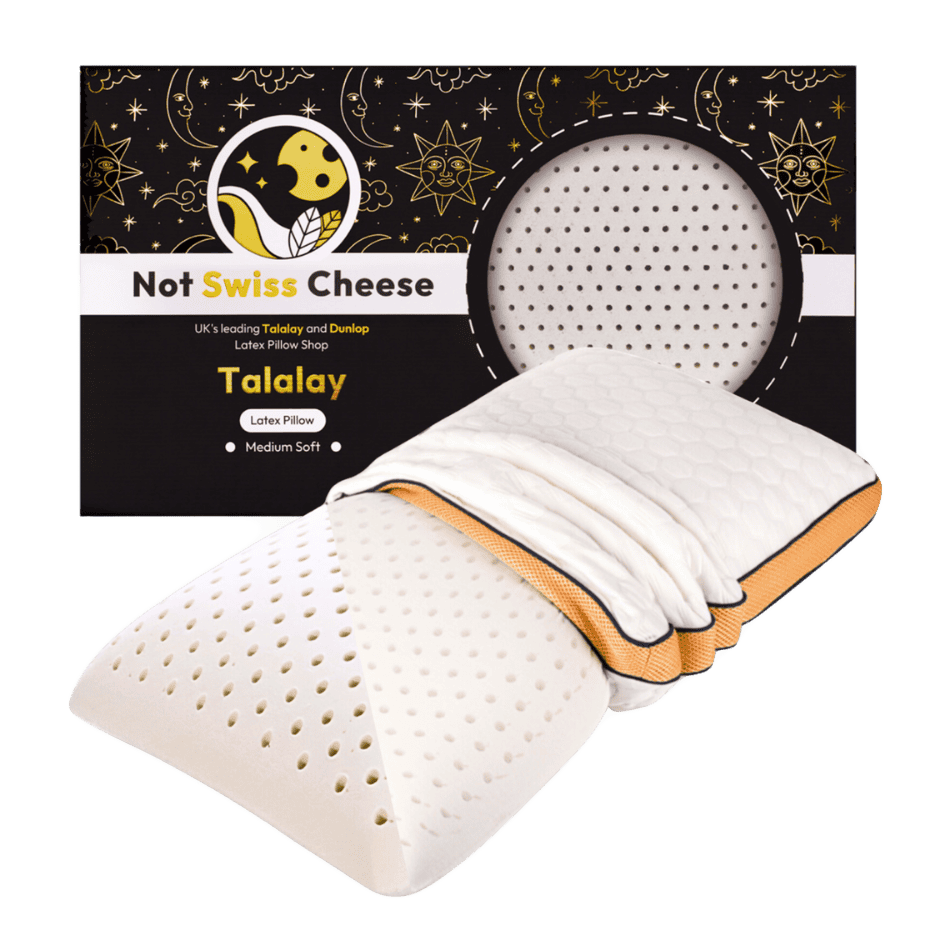
Our Pillows

Natural Latex · Made Without the Holes

The Best Pillow Is the One That Pushes Back

Most pillows are full of holes — in their materials and their marketing. Ours are 100% natural latex: springy, breathable, and supportive for a decade, not a season. Find the right one for how you actually sleep.

✓ 100-night trial ✓ Free UK delivery ✓ 8,000+ happy sleepers

Find Your Pillow by How You Sleep

There's no single "best pillow" — there's the best pillow *for you*, and that depends on three things: your sleeping position, your build, and what your current pillow is doing wrong. Side sleepers need more height than back sleepers. Anyone waking with a stiff neck usually needs more support, not more softness. And if your pillow needs fluffing, folding, or replacing every year, the material is the problem.

Every pillow below is made from 100% natural latex — tapped from rubber trees, not brewed from petrochemicals — so whichever you choose, you get the same foundation: responsive support that holds your spine in line, open-cell breathability that sleeps cool, and a lifespan of ten years or more.

Why "Not Swiss Cheese"?

Most sleep brands are full of holes: saggy foam, mystery materials, marketing fluff. We left the holes in the latex, where they belong.

Latex foam is naturally full of tiny pinholes — that's what makes it breathable, springy and cool. The gaps in everyone else's quality? Those we got rid of.

Holes in the Cheese. Never in the Support.
The latex lab

Holes in the Cheese. Never in the Support.

Natural latex does what memory foam can't: it pushes back. Here's why we built the whole brand on it.

🌿

100% natural latex

Tapped from rubber trees, not brewed from petrochemicals. Ethically sourced, biodegradable, and free of the chemical off-gassing smell memory foam is known for.

❄️

Sleeps genuinely cool

Latex foam is naturally full of tiny pinholes that circulate air all night — no heat-trapping, no clammy 3am pillow flip. That's what "made without the holes" doesn't mean: we left the holes in the latex, where they belong.

🦴

Support that never sags

Responsive and springy for a decade-plus. It holds your spine; it doesn't swallow it. Compare that to memory foam (2–3 years) or polyester hollowfibre (12–18 months) and the price per year of good sleep looks very different.

The honest FAQ

help

What is the best type of pillow to buy?

The best pillow matches your sleeping position and holds its shape. Natural latex is widely considered the best all-round material: it supports the neck like a firm pillow but cushions like a soft one, sleeps cooler than memory foam, and lasts around ten years — five times longer than polyester. Side sleepers should choose a higher, firmer profile; back sleepers a medium loft; front sleepers a slim, soft pillow.

help

What is the healthiest type of pillow to sleep on?

A pillow that keeps your neck aligned with your spine — and that's about support and height more than filling. Natural latex scores well on both health fronts: it provides consistent spinal alignment, and it's naturally resistant to dust mites and mould, which matters for allergy sufferers. It's also made without the petrochemical foams and adhesives found in many synthetic pillows.

help

Which pillows do hotels in the UK use?

Most UK hotels — including the big chains — use plump microfibre or down-alternative pillows, usually two per bed in different densities. They feel luxurious for a night because they're new and generously filled, but they're replaced constantly; the same pillow at home flattens within months. If you love the hotel feel but want it to last, latex gives you the same "full" loft that doesn't collapse.

help

Why do hotel pillows feel so comfortable?

Three reasons: they're new (hotels replace pillows far more often than households do), they're generously overfilled, and beds are dressed with multiple pillows of different firmness so you can mix your own height. You can recreate this at home by replacing tired pillows and layering a firmer base pillow with a softer top one — or by choosing one latex pillow at the correct height, which does the job of two.

help

What pillows should side sleepers avoid?

Soft, flat, or collapsing pillows. On your side, there's a 10–15cm gap between your ear and the mattress; a thin pillow lets your head drop and bends your neck sideways all night. Side sleepers should also be wary of traditional memory foam, which compresses under sustained pressure and loses height as it warms. Choose a firm, high-loft pillow that keeps your nose in line with your breastbone.

help

Is it better to have a firm or soft pillow?

It depends on your sleeping position and build. Side sleepers generally need firm and high; back sleepers medium; front sleepers soft and slim. Bigger, broader-shouldered sleepers need firmer support than lighter sleepers. The real test: lie in your normal position — your head should sit level, neither propped up nor sinking. Latex is useful here because it behaves firm *and* soft: supportive underneath, cushioned at the surface.

help

How often should you replace your pillow?

It depends entirely on the filling. Polyester and hollowfibre pillows flatten within 12–18 months. Feather and down last 2–5 years with regular plumping. Memory foam degrades in 2–3 years. Natural latex lasts 8–10+ years without losing support. A quick test for any pillow: fold it in half — if it doesn't spring back, it's no longer supporting your neck.

help

What are the negatives of memory foam pillows?

Memory foam sleeps hot (it's a closed-cell foam that traps body heat), responds slowly (you sink in and stay in, which can strain the neck when you change position), can off-gas a chemical smell when new, and softens permanently within a couple of years. It's also petrochemical-based. Latex was actually the original "foam pillow" — it delivers the contouring people want from memory foam, without the sink, the heat, or the short lifespan.

help

What is the 2 2 1 pillow rule?

The "2-2-1 rule" is a bed-styling guideline — two standard pillows, two shams, one accent cushion — not a sleep recommendation. For actually sleeping, most physiotherapists recommend one good pillow at the correct height for your position. Stacking two pillows to get enough height usually creates an unstable, uneven surface; a single taller, firmer pillow aligns the neck far better.

help

How many pillows should you sleep with?

One — provided it's the right height. NHS guidance on neck pain suggests keeping your neck in a neutral line with your spine, which one correctly sized pillow does best. Two stacked pillows tend to push the head too far forward (on your back) or create a slope (on your side). If you currently need two pillows to feel supported, that's a sign your pillow is too flat, not that you need a second one.

help

Are expensive pillows actually worth it?

Judge it on price per year, not price per pillow. A £15 polyester pillow replaced every year costs more over a decade than a £70–£90 latex pillow that lasts the full ten — and you spend those ten years properly supported. Where expensive pillows *aren't* worth it: paying a premium for branding on the same microfibre filling. Pay for the material, not the marketing.

help

What kind of pillow do doctors and physiotherapists recommend?

For most people: a supportive pillow at the correct height for their sleeping position, replaced before it collapses. For neck pain specifically, physiotherapists often suggest contoured or cervical pillows that support the curve of the neck — which is exactly what an orthopaedic latex pillow does, with the advantage that latex holds that shape for years rather than months.