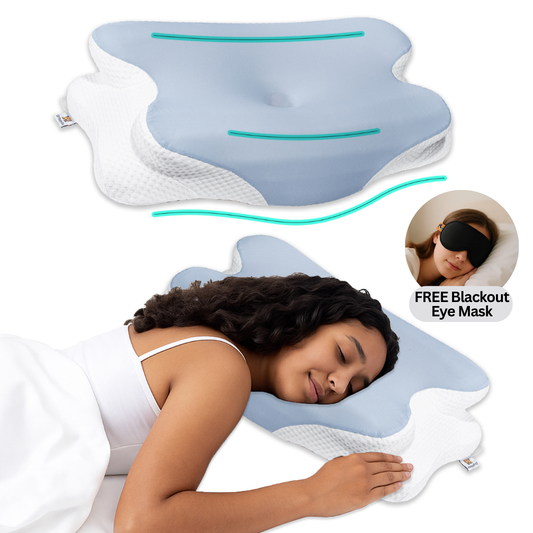
Why Latex? What Makes It Different From Everything Else
Latex comes from the harvested sap of Hevea brasiliensis — the rubber tree — making it one of the few genuinely plant-derived sleep materials commercially available at scale. It behaves in a way that's fundamentally distinct from memory foam, polyester fill, or down, and understanding that distinction is the starting point for any honest pillow conversation.
Memory foam slowly absorbs pressure and holds it. You sink in, the foam molds around you, and it releases gradually when you move. That quality is what makes it feel cradling — and what makes it feel sluggish when you shift positions in the night. Latex does the opposite. It pushes back immediately, with a responsive spring that moves with you rather than lagging behind. For combination sleepers who rotate between their side, back, and front across a single night, that responsiveness is a material advantage — quite literally.
Latex also sleeps significantly cooler than memory foam. Its open-cell structure allows air to circulate throughout the fill rather than trapping heat against the head and neck. For anyone who wakes in the night feeling overheated, this single property can be transformative.
From a durability standpoint, a well-made natural latex pillow should remain structurally sound for anywhere between 8 and 12 years. Polyester fill pillows typically degrade meaningfully within 18 months to two years. Down is variable but rarely delivers more than four or five years of consistent loft. The higher upfront cost of latex amortises well over time when measured against how frequently alternatives need replacing.
Finally, natural latex is inherently resistant to dust mites, mould, and the most common household allergens. This isn't a marketing claim — it's a physical property of the material. The dense rubber matrix doesn't provide the warm, moist, porous environment that dust mites require to colonise. For allergy sufferers, this is a genuine, functional benefit rather than a wellness buzzword.
One important caveat: the word "latex" on a product label means almost nothing without qualification. Synthetic latex — a petroleum-derived foam engineered to mimic the bounce of natural rubber — is perfectly legal to sell under the same name. It lacks the breathability, hypoallergenic properties, and longevity of natural latex, but it's significantly cheaper to produce. Blended products can legally describe themselves as latex while containing mostly polyurethane foam with only trace amounts of natural rubber. When buying, always look for 100% natural latex, and ideally for third-party certification such as the Global Organic Latex Standard (GOLS), which verifies both the organic origin of the latex and the processing conditions under which it was produced.
Dunlop vs. Talalay: The One Technical Distinction Worth Understanding
Every latex pillow on the market — genuine natural latex, at least — is produced by one of two manufacturing processes. They produce materials that feel noticeably different, and knowing which suits your sleep position can save you from buying the wrong thing.
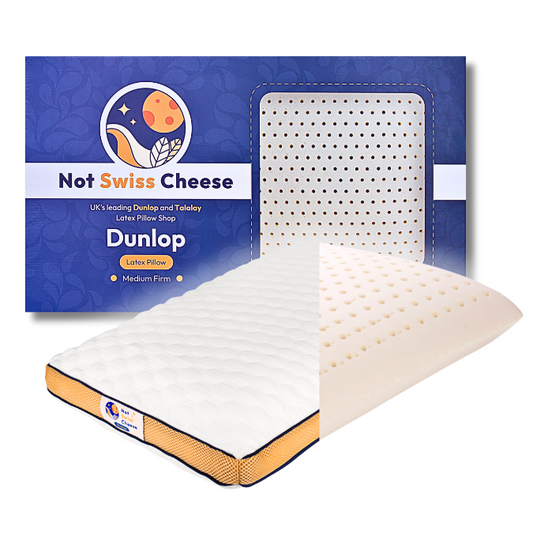
Dunlop is the original method, developed in the 1920s. Liquid latex is poured into a mould and vulcanised (cured with heat). During the baking process, natural sediment settles toward the bottom of the mould, which means Dunlop latex is denser and heavier at the base than the top. This creates a firm, grounded, stable feel — often described as sturdy rather than springy. Dunlop holds its structure exceptionally well over time, with lifespans typically reaching 10 to 12 years. It's also the less resource-intensive process, making it the lower-cost and marginally lower-carbon option.
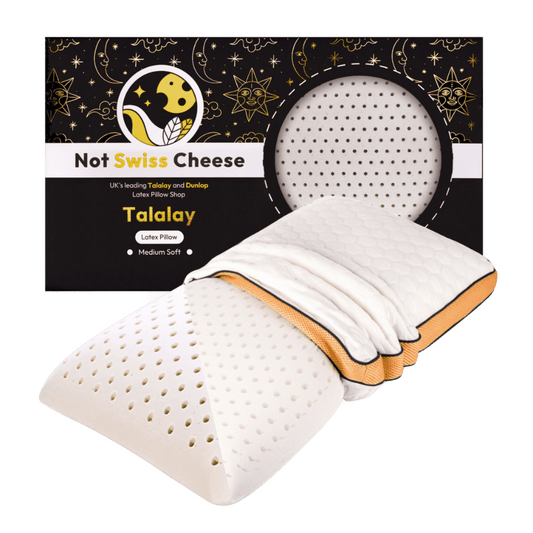
Talalay is more complex. After the liquid latex is poured, two additional steps precede baking: the mould is vacuum-sealed (causing the latex to expand and fill every corner uniformly) and then flash-frozen before heat-curing. This produces a latex with an even, aerated cell structure throughout — no density gradient from top to bottom. The result is softer, lighter, and springier than Dunlop, with a buoyancy that's frequently described as cloud-like. Talalay is also more breathable due to its more open cellular structure. The trade-off is cost (typically 20–30% more than comparable Dunlop products) and a slightly shorter lifespan of 8–10 years.
In practical terms: Dunlop tends to suit back and stomach sleepers who benefit from firm, consistent support and don't need the material to compress significantly. Talalay is generally preferred by side sleepers and hot sleepers — the softness accommodates shoulder and hip contouring, and the enhanced breathability helps with temperature regulation overnight.
|
Dunlop |
Talalay |
|
|
Feel |
Firm, dense, grounded |
Soft, springy, buoyant |
|
Breathability |
Good |
Better |
|
Lifespan |
10–12 years |
8–10 years |
|
Cost |
Lower |
20–30% more |
|
Best suited to |
Back and stomach sleepers |
Side sleepers, hot sleepers |
|
Manufacturing impact |
Simpler process, less energy |
More steps, more resources |
Solid vs. Shredded: Which Construction Actually Works for You
Beyond the latex type, you'll encounter two structural formats: solid (one-piece moulded) and shredded (loose fill inside a casing).
Solid latex pillows hold a fixed shape night after night. There's no bunching, no migration, no flat spots developing in areas of sustained pressure. The support they provide is completely consistent — you know exactly what you're getting every night. This makes them particularly well-suited to back sleepers, who benefit from a reliable, defined loft that maintains consistent cervical alignment without shifting. The limitation is that solid pillows aren't adjustable — you need to choose the right height at the point of purchase.
Shredded latex pillows can be scrunched, folded, pushed into a side, or redistributed to build up support in a specific area. Many also allow you to add or remove fill through a zip compartment to dial in your exact preferred loft. This adjustability makes shredded pillows particularly valuable for stomach sleepers (who typically need very low loft and benefit from the ability to remove fill until the pillow sits almost flat) and for people who are genuinely uncertain what height works best for them. The trade-off is precision — shredded fill never provides quite the same level of exact, reproducible support that a solid moulded core does.
Loft by Sleep Position
The height of your pillow — its loft — has a direct impact on whether your cervical spine is aligned or stressed during sleep. Too high and the head is pushed forward, compressing the neck; too low and the head drops, overstretching the opposite side.
Side sleepers need the most loft. The pillow must bridge the full distance from the mattress surface to the side of the head, spanning the shoulder. For most adults, this means 15–18cm (approximately 6–7 inches). Back sleepers need moderate loft — roughly 10–13cm (4–5 inches) — sufficient to support the natural curve of the neck without elevating the head excessively. Stomach sleepers benefit from minimal loft — ideally under 8cm (3 inches) — to prevent the neck from cranking sharply upward against the weight of the head.
The Certifications That Actually Mean Something
The pillow market is awash in claims that look like certifications but aren't. Here are the ones worth paying attention to:
GOLS (Global Organic Latex Standard) verifies that the latex is derived from certified organic rubber tree plantations, and that the processing facility meets standards for worker welfare and chemical use. This is the only meaningful standard specifically for latex quality and origin.
GOTS (Global Organic Textile Standard) applies to the textile components — covers, casings, and fabric elements — and ensures they're produced from certified organic fibres without prohibited chemicals throughout the supply chain.
OEKO-TEX Standard 100 tests the finished product for harmful substances. It doesn't certify organic sourcing but does confirm the pillow is free from a defined list of problematic chemicals at the levels tested.
GREENGUARD Gold is a chemical emissions standard that certifies low VOC (volatile organic compound) off-gassing. It's particularly relevant for people sensitive to new-product smells and is a credible independent certification even if it doesn't speak to organic sourcing.
Responsible Wool Standard (RWS) applies specifically to wool components, certifying humane animal welfare practices and land management standards. Relevant for pillows that incorporate wool in the cover or fill.
The Six Best Latex Pillows Worth Buying
1. Best Overall: Saatva Latex Pillow
Fill: Shredded Talalay core with removable microfibre outer layer
Loft: Approximately 20cm (adjustable by removing outer layer)
Price: £130–£155 (equivalent; check current UK pricing)
Trial: 45 nights
Best for: Back and side sleepers who want versatility without compromise
The Saatva earns the top position not because it excels in one particular way but because it doesn't fall short in any meaningful way. That's rarer than it sounds in this category, where most pillows make a compelling case for one type of sleeper while being genuinely unsuitable for another.
The architecture is thoughtful. A shredded Talalay latex core provides the responsive, temperature-neutral base. Around that core sits a removable microfibre outer layer that adds plushness and bulk — and crucially, can be removed entirely to reduce the loft for back and stomach sleeping. This dual-layer adjustability is more practical than the conventional zip-and-scoop approach of most shredded pillows, and it gives the Saatva a feel that's unusually soft for a latex product — closer to a high-quality down alternative pillow that happens to push back against your head with the support structure of natural rubber.
The organic cotton sateen cover is genuinely nice. Not nice in a marketing-copy sense but in the tangible, tactile sense of something that feels considered — smooth against the face, breathable throughout the night, and finished in a way that signals product quality rather than cutting costs on the last step.
The main arguments against it are the price (it's unambiguously a premium purchase) and the core's machine-washing restriction, which applies to virtually all latex cores. On sale, the value proposition strengthens considerably.
2. Best for Neck Support: Avocado Molded Latex Pillow
Fill: Solid moulded latex with charcoal infusion
Loft: Fixed (medium-firm)
Price: Approximately £95–£110
Trial: 100 nights
Certifications: GREENGUARD Gold, GOLS
Best for: Back sleepers, people with cervical pain or neck stiffness
The Avocado is the specialist pick in this lineup. If neck alignment is your primary concern — if you regularly wake with stiffness, have been told by a physiotherapist or osteopath that your sleep posture is problematic, or have had a cervical injury that makes consistent support non-negotiable — this is where to spend your money.
The solid moulded core is the reason. Unlike shredded fills that redistribute overnight, the Avocado's one-piece latex construction maintains precisely the same geometry from the first night to the thousandth. The charcoal infusion serves a dual function that's genuinely functional rather than decorative: activated charcoal regulates temperature by absorbing and releasing heat, and its porous structure captures odour molecules. Over extended use, testers consistently report that the Avocado stays fresher and cooler than non-charcoal alternatives.
The hand-stitched organic cotton cover has a slight stretch to it that allows it to contour over the moulded shape without pulling tight. The GREENGUARD Gold certification adds meaningful reassurance around chemical emissions — worth noting for anyone with chemical sensitivities or buying for a child's room.
The limitation is inflexibility — this is not an adjustable pillow, and its fixed medium-firm loft may run slightly low for side sleepers with very broad shoulders. For that use case, the Saatva or Naturepedic would serve better. For back sleepers, it's arguably the best cervical support pillow available at this price point.
3. Best Organic: PlushBeds Organic Shredded Latex Pillow
Fill: 100% GOLS-certified shredded Dunlop latex
Loft: Adjustable
Price: Approximately £80–£115
Certifications: GOLS, GOTS, OEKO-TEX
Best for: Eco-conscious buyers, allergy sufferers, those avoiding all synthetic materials
If your primary motivation for buying latex is to avoid synthetic fill materials, PlushBeds is the most straightforward expression of that goal. The fill is 100% GOLS-certified shredded Dunlop latex — there is no polyester blended in, no synthetic foam used as a carrier material, no ambiguity about what's inside the cover. This matters because the majority of "latex" pillows at comparable price points use synthetic latex or latex-foam blends that carry the natural rubber branding without the substance.
The shredded Dunlop construction gives the pillow a feel that's sometimes surprising to people expecting the springy bounce of Talalay. Dunlop shredded feels denser and more substantive — less like a cloud, more like a well-packed traditional pillow that happens never to clump or go flat. The comparison to natural down is apt: it has that malleable, adjustable quality without the compression over time that makes down lose its loft.
The certification stack — GOLS for the latex, GOTS for the cotton cover, OEKO-TEX for the finished product — is the strongest of any pillow in this roundup. For buyers who research their purchases carefully and want independent third-party verification of what they're buying, this matters.
The trade-off is felt. Shredded Dunlop is not for everyone. Those accustomed to the plush, uniform softness of Talalay may find it too firm or too dense. If softness is your priority alongside organic credentials, the Saatva uses Talalay at a higher price point and is still certified. But if purity of material is the priority, PlushBeds is the answer.
4. Best Budget: Brooklyn Bedding Talalay Latex Pillow
Fill: Solid Talalay latex
Loft: Fixed (available in multiple firmness levels)
Price: Approximately £55–£75
Trial: 30 nights
Warranty: 1 year
Best for: Budget-conscious shoppers, people new to latex, Talalay converts
The Brooklyn Bedding pillow makes a straightforward case: genuine Talalay latex at a price point roughly 40% below the premium brands. That's the entirety of its pitch, and it's a good one.
What's notable about it is the absence of the corner-cutting that usually accounts for a lower price. Many budget "latex" pillows achieve their price by using synthetic latex or thin blends that feel similar on the first night and degrade rapidly thereafter. Brooklyn Bedding uses real Talalay throughout — the same responsive, springy, temperature-neutral material you'd find in a pillow costing twice as much. The cell structure is genuine, the feel is genuine, and while it won't outlast a premium Dunlop product, it should perform consistently for several years.
The availability of multiple firmness options is a genuine practical advantage. Many pillows — including some at much higher price points — offer only a single firmness with no meaningful ability to customize. Being able to select Soft, Medium, or Firm at the point of purchase based on your sleep position is a straightforward way to improve the likelihood of buying the right product the first time.
The limitations are real: the 30-day trial period is the shortest in this roundup, and the one-year warranty is shorter than the two-to-five-year coverage offered by premium brands. These are the areas where the cost saving shows. But for first-time latex buyers, those on a tighter budget, or anyone who wants to experience real Talalay before committing to a premium investment, Brooklyn Bedding is a sensible starting point.
5. Best Adjustable: Naturepedic 2-in-1 Organic Latex Pillow
Fill: Adjustable shredded latex
Cover: Dual-sided (stretch-knit on one side, quilted on the other)
Price: Approximately £105–£120
Certifications: GOLS, GOTS
Best for: Combination sleepers, couples with different preferences, anyone still finding their ideal loft
The Naturepedic 2-in-1 is the pick that rewards people who are genuinely uncertain about what they need. The dual-sided cover is the headline feature — one face is a breathable stretch-knit for warmer nights or those who prefer a cooler surface; the other is a quilted layer for extra softness. Flipping the pillow genuinely changes how it feels, which is a meaningful option for sleepers whose preferences shift seasonally or situationally.
But the more practically significant feature is the fill adjustment system. A zip access point allows you to add or remove shredded latex fill through a separate inner compartment — critically, without the loose fill mixing with the washable outer shell. This design solves one of the ongoing frustrations with adjustable pillows, which typically require either removing fill messily by hand or accepting imprecise adjustment. The segregated compartment system makes adding and removing fill clean and precise. Finding your ideal loft requires some experimentation over the first few nights, but once you've dialled it in, you have a pillow calibrated specifically to your dimensions and position.
The organic credentials are solid: GOLS-certified latex, GOTS-certified cotton cover. The pillow runs heavier than average due to the dual-layer construction and fill volume, which is worth knowing if you move your pillow around frequently during the night.
6. Best for Hot Sleepers: Birch Organic Talalay Latex Pillow
Fill: Talalay latex with wool
Cover: Organic cotton and wool
Price: Approximately £120–£140
Certifications: GOLS, GOTS, Responsible Wool Standard
Best for: People who sleep hot, back and side sleepers, buyers prioritising ethical sourcing
Birch — the organic sub-brand of mattress maker Helix — designed this pillow specifically around temperature regulation, and the engineering reflects that priority throughout rather than just in the marketing copy.
The Talalay core provides the baseline breathability that latex is known for. But the differentiating factor is the cover: organic cotton combined with wool. Wool is a natural thermoregulator in a way that most synthetic cooling technologies simply aren't. It wicks moisture away from the face, absorbs up to 30% of its own weight in moisture vapour before feeling damp, and moderates the microclimate between your head and the pillow regardless of room temperature. In practical terms: if you sleep hot, the Birch doesn't just passively allow heat to dissipate — it actively moves moisture away from the point of contact. The difference is perceptible.
The pillow sits on the firmer side for a Talalay product, which suits back sleepers well and is adequate for most side sleepers, though those with very broad shoulders may want the additional height of a dedicated side-sleeping pillow. The Responsible Wool Standard certification ensures the wool is sourced from farms meeting animal welfare and land management benchmarks — a detail that matters to an increasing number of buyers and represents genuine verification rather than a self-applied label.
The cover cannot be machine-dried — it must be air-dried to protect the wool fibres. Worth knowing before purchasing, though hardly unusual for wool-containing textiles.
Comparing the Picks
|
Pillow |
Fill |
Construction |
Best For |
Approx. UK Price |
Trial |
|
Saatva Latex |
Shredded Talalay |
Adjustable dual-layer |
Back & side sleepers |
£130–155 |
45 nights |
|
Avocado Molded |
Solid Dunlop + charcoal |
Fixed |
Neck pain, back sleepers |
£95–110 |
100 nights |
|
PlushBeds Shredded |
Shredded Dunlop |
Adjustable |
Eco-conscious, allergy sufferers |
£80–115 |
Varies |
|
Brooklyn Bedding |
Solid Talalay |
Fixed (multi-firmness) |
Budget buyers |
£55–75 |
30 nights |
|
Naturepedic 2-in-1 |
Shredded latex |
Adjustable dual-sided |
Combination sleepers |
£105–120 |
Varies |
|
Birch Organic |
Talalay + wool |
Fixed |
Hot sleepers |
£120–140 |
Varies |
How to Care for a Latex Pillow (And Make It Last a Decade)
The single most important rule: the latex core should never go into a washing machine or tumble dryer. The agitation of a wash cycle and the heat of a dryer will both destroy the cellular structure of the latex, degrading it from a resilient, responsive material into a crumbling, uneven mass. This isn't recoverable. A latex pillow exposed to machine washing is essentially ruined.
For cleaning the core itself, spot treatment is the correct approach. Dampen a cloth with a mild detergent solution, blot the affected area gently (don't scrub), then press dry towels against the spot to absorb moisture. Lay the pillow flat and allow it to air dry completely away from direct sunlight — UV radiation degrades natural latex over time, causing it to yellow and become brittle.
The removable cover is a different matter. Most quality latex pillows come with a zip-off cover that is machine washable. Washing this a few times a year — or whenever it needs it — is sufficient. The hypoallergenic properties of the latex core itself reduce the accumulation of allergens that would otherwise necessitate frequent washing.
A quality pillow protector placed over the cover is worth the modest investment. It provides an additional washable barrier that extends the time between cover washes and protects the latex from sweat and oils that gradually permeate through cover fabric over months of use.
When to replace it: Natural latex is durable, but not permanent. Indicators that it's time to replace: you're waking with neck or shoulder stiffness that wasn't present before and doesn't resolve during the day; pressing the pillow firmly and releasing it shows the foam no longer springing back promptly to its original shape; visible yellowing or a persistent rubbery smell that doesn't dissipate with airing. Talalay products typically reach this point after 8–10 years. Well-maintained Dunlop can hold up for 12 or more.
Here's a fully rephrased, long-form affiliate article targeting UK readers:
How to Care for a Latex Pillow (And Make It Last a Decade)
The single most important rule: the latex core should never go into a washing machine or tumble dryer. The agitation of a wash cycle and the heat of a dryer will both destroy the cellular structure of the latex, degrading it from a resilient, responsive material into a crumbling, uneven mass. This isn't recoverable. A latex pillow exposed to machine washing is essentially ruined.
For cleaning the core itself, spot treatment is the correct approach. Dampen a cloth with a mild detergent solution, blot the affected area gently (don't scrub), then press dry towels against the spot to absorb moisture. Lay the pillow flat and allow it to air dry completely away from direct sunlight — UV radiation degrades natural latex over time, causing it to yellow and become brittle.
The removable cover is a different matter. Most quality latex pillows come with a zip-off cover that is machine washable. Washing this a few times a year — or whenever it needs it — is sufficient. The hypoallergenic properties of the latex core itself reduce the accumulation of allergens that would otherwise necessitate frequent washing.
A quality pillow protector placed over the cover is worth the modest investment. It provides an additional washable barrier that extends the time between cover washes and protects the latex from sweat and oils that gradually permeate through cover fabric over months of use.
When to replace it: Natural latex is durable, but not permanent. Indicators that it's time to replace: you're waking with neck or shoulder stiffness that wasn't present before and doesn't resolve during the day; pressing the pillow firmly and releasing it shows the foam no longer springing back promptly to its original shape; visible yellowing or a persistent rubbery smell that doesn't dissipate with airing. Talalay products typically reach this point after 8–10 years. Well-maintained Dunlop can hold up for 12 or more.
Frequently Asked Questions
Is latex safe for people with latex allergies?
This requires careful attention. Natural latex contains proteins that can trigger reactions in people with a diagnosed latex allergy (Type I hypersensitivity). However, processing latex into foam for pillows removes most of these proteins, and the incidence of reactions to latex pillows is very low even among people who react to latex gloves or medical equipment. That said, if you have a confirmed latex allergy, consult an allergist before purchasing. Synthetic latex and latex-alternative pillows are safer options for confirmed allergy sufferers.
How do I know what loft (height) is right for me?
The simple starting point: measure your shoulder width. If you're a side sleeper, the pillow needs to approximately match the distance from your mattress surface to your head — roughly your shoulder width. Most side sleepers do well in the 15–18cm range. Back sleepers generally want 10–13cm. Stomach sleepers do best under 8cm. If you're buying your first latex pillow and are unsure, an adjustable shredded option gives you the flexibility to find the right loft through experimentation.
Can two people share one latex pillow?
In the sense of sleeping on the same pillow simultaneously — no, this isn't what body pillows or standard pillows are designed for. However, for couples with different loft preferences buying pillows for a shared bed, the adjustable shredded options (Saatva, Naturepedic, PlushBeds) allow each person's pillow to be tuned independently to their requirements.
Does latex have an initial smell?
New latex pillows can have a mild rubber smell on first opening, which is natural and not indicative of harmful chemical off-gassing. It typically dissipates within 24–72 hours of airing. If a strong smell persists for more than a week, that can indicate a lower-quality product containing synthetic blends. GREENGUARD Gold-certified pillows have been independently tested for chemical emissions — the Avocado pick carries this certification.
Are UK shoppers able to access these brands?
Several of the brands listed here (Saatva, Avocado, Brooklyn Bedding) are primarily US-based and may not offer direct UK shipping. Comparable alternatives available in the UK include Eve Sleep's hybrid pillow range, Emma's latex options, and Naturalmat for organic-certified products. The buying criteria outlined in this guide apply regardless of brand — focus on confirmed natural latex, GOLS certification if organic matters to you, and a trial period that gives you genuine time to evaluate the product.
The Bottom Line
If you want a single clear recommendation for most sleepers, the Saatva Latex Pillow is the hardest to get wrong. It's versatile, adjustable, well-made, and manages to feel luxurious in a way that most latex pillows — which can feel clinical in their firmness — don't.
If budget is the priority, Brooklyn Bedding's Talalay pillow delivers the real thing at a price that's genuinely hard to argue with, particularly when on sale.
If you sleep hot, Birch's organic pillow is the only one in this list where the cover actively moves heat and moisture away from your face rather than just passively allowing airflow.
If organic certification is non-negotiable, PlushBeds has the strongest certification stack and the cleanest material composition of any pillow at its price.
Whatever you choose: confirm it's 100% natural latex with a credible third-party certification, not a synthetic blend that carries the latex name. The difference in feel, durability, breathability, and genuine sleep quality over the years of use that follow that purchase is substantial enough to make the research worthwhile.
Author
Jayant Upadhyay is a health writer and content strategist with 13+ years of experience in SEO-driven content and research-led publishing. He has created 5,000+ articles across health, wellness, and lifestyle, focusing on evidence-based insights that improve sleep, well-being, and everyday health outcomes for global audiences.
https://www.linkedin.com/in/jayant-upadhyay-3a385228/?skipRedirect=true