Most people spend more time choosing a mattress than a pillow. That's a mistake — especially if you sleep on your side.
Here's a number worth sitting with: roughly 69% of adults worldwide sleep on their side, making it the single most common sleep position. And yet most side sleepers are using a pillow designed for back sleepers — or worse, no particular sleeper at all.
The wrong pillow doesn't just cause minor discomfort. Over time, poor neck alignment during sleep is linked to chronic shoulder tension, upper back pain, and disrupted sleep quality. One study published in the Journal of Pain Research found that neck pain affects up to 50% of adults annually, and sleep posture is among the most cited contributing factors.
So — what does "the right pillow for a side sleeper" actually mean? Let's break it down properly.
69% of adults sleep on their side — the most common position globally
50% of adults report neck pain annually, often linked to sleep posture
7–9 hrs average sleep time — meaning your pillow works that long every night
3–5 yrs recommended replacement cycle for most pillow types
Sources: Sleep Foundation global sleep survey; Journal of Pain Research (2021); American Academy of Sleep Medicine.
Why side sleepers need a different pillow entirely
When you sleep on your side, there's a gap between your head and the mattress — the width of your shoulder. Your pillow's entire job is to fill that gap and keep your head, neck, and spine in a straight, neutral line.
Back sleepers only need a moderate amount of support because their shoulder isn't in the picture. Stomach sleepers need very flat support. Side sleepers need the most loft (height) of any sleep position — and they need it to stay consistent throughout the night, not compress down to nothing by 3 am.
If you wake up with stiffness in the neck or shoulders, the first thing to check isn't your mattress — it's whether your pillow is maintaining your neck's neutral alignment for the full night.
A 2019 study from the Journal of Manipulative and Physiological Therapeutics found that participants who switched to a supportive, correctly-lofted pillow reported a significant reduction in neck pain and improved sleep quality within four weeks. The change wasn't dramatic — it was just the right height and firmness for their sleeping position.
What to look for — the four things that actually matter
Factor 1
Loft (height)
Side sleepers need medium-to-high loft — typically 4–6 inches. Too low and your neck bends down; too high and it bends up. Both cause the same shoulder and neck tension.
Factor 2
Firmness
Medium-to-firm is the right range. A soft pillow compresses under the weight of your head and loses its loft by morning — giving you the illusion of support without the reality of it.
Factor 3
Fill material
The fill determines how consistently support is maintained. Memory foam and dense fibre maintain loft reliably. Down and cheap polyester compress and clump — they feel luxurious but fail at their core job.
Factor 4
Breathability
Core body temperature drops during sleep. Materials that trap heat — including standard memory foam — can disrupt this. In warm climates, breathability isn't a bonus feature; it's a requirement.
If you share a bed, also check pillow shape. A contoured pillow with raised edges cradles the neck and doesn't transfer movement — helpful if your partner moves during the night.
The four pillow types that work for side sleepers
Not every pillow marketed as "ergonomic" actually helps. These four types have consistent evidence behind them for side sleeping specifically.
|
Pillow type |
Best for |
Watch out for |
Rating |
|
Contoured memory foam |
Neck and shoulder soreness; those who stay in one position |
Heat retention in standard foam; not adjustable |
Best overall |
|
Gel-infused fibre |
Hot sleepers; warm climates like most of India |
Can compress faster than solid foam over time |
Best for heat |
|
Adjustable fill |
Sleepers who don't know their ideal loft yet |
Requires experimentation; fill can shift unevenly |
Good starter |
|
Latex |
Durable, natural option; good for allergy-prone sleepers |
Heavy; some find it too firm; higher price point |
Good long-term |
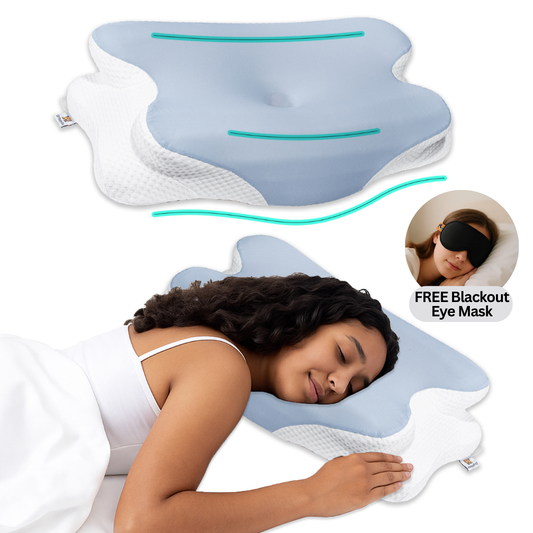
Contoured pillows — the ergonomic choice
The raised edges and central dip of a contoured pillow are specifically designed to fill the shoulder gap and cradle the neck. Research on ergonomic bedding consistently shows contoured pillows outperform flat pillows for side sleepers on both alignment and pain reduction metrics. If you wake up stiff regularly, this is usually the first switch worth making.
Memory foam — personalised support that doesn't shift
Memory foam responds to heat and pressure, adapting to the exact shape of your head and neck. Unlike loose fills that shift through the night, a solid foam core maintains its shape until morning. The main limitation is heat — standard memory foam traps warmth. Gel-infused versions solve this, which is why they've become the preferred option in warmer climates.
Gel-infused and cooling pillows — underrated in India's climate
Sleep researchers have established that the ideal bedroom temperature for sleep is between 18–20°C. In most Indian cities during summer, bedroom temperatures regularly exceed this — which is why cooling materials aren't a luxury. Gel fibre pillows like Sealy's Gel Luxe range are specifically engineered to improve airflow and dissipate heat while maintaining firm support for side sleepers.
Adjustable pillows — for those still finding their fit
If you're not sure what loft height works for you, adjustable pillows let you add or remove fill until you find the right height. They're a good entry point, though once you've found your ideal loft, a purpose-built option usually performs more consistently.
Avoid standard down or low-density polyester fills for side sleeping. They compress under the weight of your head within an hour or two, leaving you without support for the majority of your night — even if they feel comfortable at first.
Quick Vastu Shastra tips for side sleepers
Beyond the physical ergonomics, many Indian households follow Vastu Shastra principles in bedroom setup. Here's how those principles apply practically for side sleepers.
Sleep direction
Vastu recommends pointing your head South or East during sleep — associated with stability and positive energy flow, and believed to encourage deeper rest.
Avoid facing North
Pointing your head North is considered disruptive to the body's natural energy balance in Vastu, potentially leading to restless or broken sleep.
Body alignment
Vastu values symmetry and balance — directly aligned with ergonomic advice. A pillow that fills the shoulder gap, plus a cushion between the knees, supports both principles.
Clear the space
Vastu advises minimising clutter around the bed, especially near the head. A calm, uncluttered sleep space genuinely reduces cognitive stimulation before sleep.
The interesting thing about Vastu and sleep ergonomics is how often they point in the same direction: reduce stimulation, maintain body balance, and create a calm, structured environment. Whether you follow Vastu out of tradition or simply find the principles sensible, they complement the physical setup well.
Your side sleeper pillow checklist
-
Medium-to-high loft — typically 4–6 inches to fill the shoulder gap
-
Medium-to-firm density — soft pillows lose their loft under head weight
-
Dense, stable fill — memory foam, latex, or quality gel fibre; avoid standard down or cheap polyester
-
Breathable materials — essential in warm climates; gel-infused options help regulate temperature
-
Contoured shape if possible — raised edges cradle the neck and maintain neutral alignment
-
Replace every 3–5 years — even quality pillows lose structural integrity over time
Frequently asked questions
What height pillow does a side sleeper actually need?
Most side sleepers need a medium-to-high loft of around 4–6 inches. The goal is to fill the space between your head and the mattress — the width of your shoulder — without pushing your head up too far. If you wake up with neck stiffness, loft is the first thing to adjust.
Should side sleepers use a firm or soft pillow?
Medium-to-firm. A soft pillow compresses under the weight of your head within an hour or two, and you spend the rest of the night without proper support — even if it felt fine when you first lay down.
Are contoured pillows actually better for side sleepers?
Yes, particularly for people who wake up with neck or shoulder soreness. The raised edges and central dip are specifically designed to cradle the neck and fill the shoulder gap — which a flat pillow does less effectively.
Can side sleepers use memory foam?
Yes — and it's one of the better options because solid foam maintains its shape through the night rather than shifting or compressing. If you sleep hot, go for a gel-infused version rather than standard memory foam.
How do I know if my current pillow is wrong for side sleeping?
The clearest signs: waking up with neck, shoulder, or upper back stiffness; needing to constantly adjust or fold your pillow during the night; or the pillow feeling flat by morning. Any of these suggest your pillow isn't maintaining alignment through the night.
Does sleeping direction matter for side sleepers in India?
From a Vastu perspective, sleeping with your head pointing South or East is recommended. From a purely ergonomic standpoint, direction matters less than alignment — though combining good pillow support with a Vastu-aligned direction gives you both physical and environmental factors working together.
Still unsure which pillow type suits your sleep style? The right answer depends on your shoulder width, sleep temperature, and whether you tend to move through the night.
Author
Jayant Upadhyay is a health writer and content strategist with 13+ years of experience in SEO-driven content and research-led publishing. He has created 5,000+ articles across health, wellness, and lifestyle, focusing on evidence-based insights that improve sleep, well-being, and everyday health outcomes for global audiences.
https://www.linkedin.com/in/jayant-upadhyay-3a385228/?skipRedirect=true